FHA Loan Requirements in 2026: Complete Homebuyer Guide
Learn the FHA loan requirements for 2026, including minimum down payment, credit guidelines, mortgage insurance, loan limits, income documentation, and property eligibility.
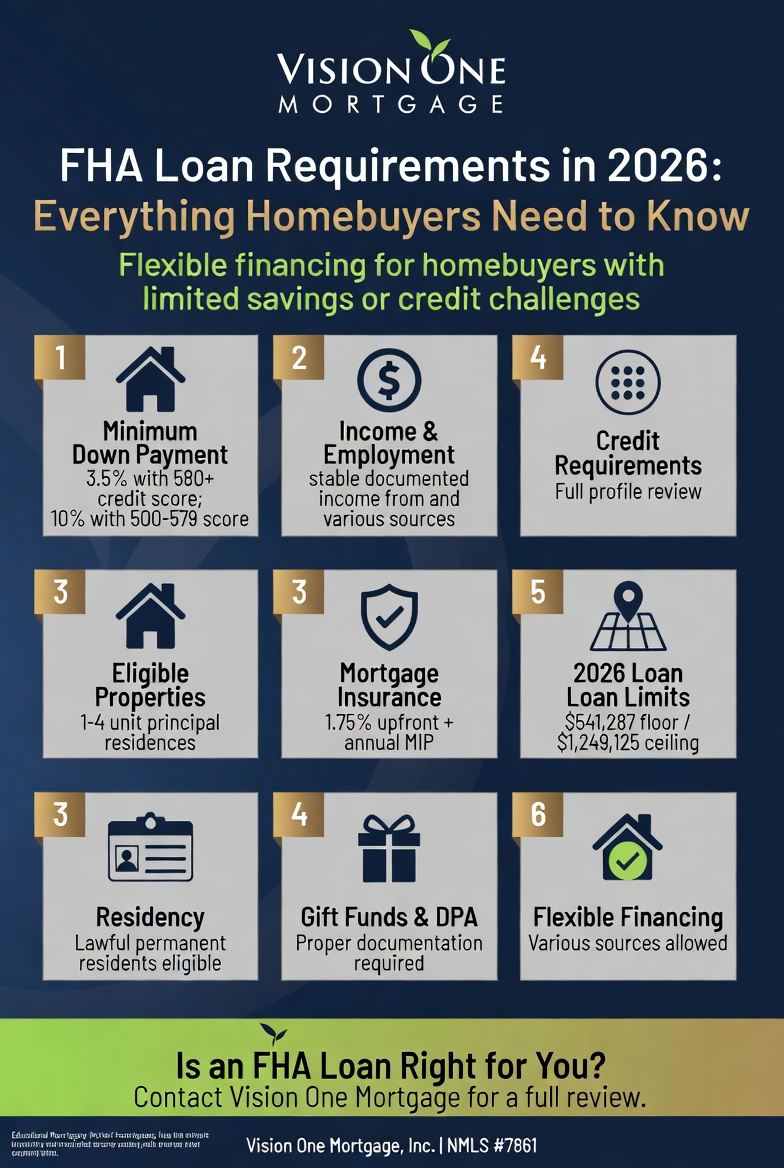
FHA Loan Requirements in 2026: Everything Homebuyers Need to Know
An FHA loan is a mortgage made by an approved lender and insured by the Federal Housing Administration. FHA financing can be an excellent option for homebuyers who have limited savings, previous credit challenges, or need more flexible qualification guidelines.
1. FHA Minimum Down Payment
The minimum required down payment can be as low as 3.5% of the adjusted property value for an eligible borrower.
Under FHA’s baseline guidelines:
- A credit score of 580 or higher may qualify for maximum financing and a 3.5% minimum investment.
- A credit score between 500 and 579 is generally limited to 90% loan-to-value, meaning at least 10% down.
Individual lenders may establish higher minimum credit-score requirements or additional underwriting overlays.
2. Income and Employment Requirements
FHA does not establish one universal minimum income amount. The borrower must demonstrate sufficient, stable and documentable income to support the proposed mortgage payment and existing obligations.
Income may potentially include:
- W-2 employment
- Self-employment income
- Social Security or pension income
- Disability or other qualifying benefits
- Alimony or child support when properly documented
- Other stable and eligible income sources
The final debt-to-income decision may depend on FHA’s TOTAL Mortgage Scorecard, automated underwriting findings, manual underwriting requirements and lender overlays.
3. FHA Credit Requirements
FHA underwriting evaluates more than the credit score. The lender may also review:
- Housing-payment history
- Collections and charge-offs
- Bankruptcy or foreclosure history
- Federal debt
- Disputed accounts
- Recent late payments
- Overall credit pattern
A lower score does not automatically mean a borrower will be approved, while a higher score does not guarantee approval. The complete loan profile must satisfy FHA and lender requirements.
4. Eligible Properties
FHA financing is generally intended for a borrower’s principal residence. Eligible property types may include one- to four-unit residential properties, subject to FHA occupancy, appraisal and property-eligibility requirements.
The property must also meet FHA’s minimum property requirements. Health, safety, structural or habitability concerns identified during the appraisal may need to be repaired before closing.
5. FHA Mortgage Insurance
Most FHA loans require two forms of mortgage insurance:
Upfront Mortgage Insurance Premium: Generally 1.75% of the base loan amount. This amount can usually be financed into the mortgage.
Annual Mortgage Insurance Premium: Paid monthly as part of the mortgage payment. The percentage depends on the loan term, base loan amount and loan-to-value ratio. For many 30-year FHA purchase loans below the applicable threshold with more than 95% LTV, the annual premium is 0.55%.
When the original LTV is more than 90%, annual mortgage insurance generally continues for the applicable mortgage term. At 90% LTV or below, it is generally assessed for 11 years.
6. FHA Loan Limits for 2026
FHA loan limits vary by county and property size.
For 2026, the national one-unit FHA loan limits range from:
- Low-cost-area floor: $541,287
- High-cost-area ceiling: $1,249,125
Higher limits apply to eligible two-, three- and four-unit properties. Borrowers should confirm the exact limit for the county where the property is located.
7. Residency Eligibility
For FHA case numbers assigned on or after May 25, 2025, HUD eliminated eligibility for non-permanent resident borrowers. Lawful permanent residents may be eligible under the same general requirements as U.S. citizens when acceptable evidence of lawful permanent residence is included in the loan file.
A Social Security card or employment authorization document alone does not establish lawful permanent resident status for FHA eligibility.
8. Gift Funds and Down-Payment Assistance
FHA may permit eligible gift funds to help with the minimum required investment or closing costs. The donor, gift letter and transfer of funds must be properly documented.
Qualified borrowers may also be able to combine FHA financing with an eligible down-payment-assistance program, subject to the requirements of both programs.
Is an FHA Loan Right for You?
FHA financing may be worth considering when you:
- Have limited funds available for a down payment
- Have experienced previous credit challenges
- Need flexible debt-to-income evaluation
- Want to purchase an owner-occupied one- to four-unit property
- Plan to use eligible gift funds or down-payment assistance
Every borrower and property is different. A complete mortgage review can determine whether FHA, conventional, VA, down-payment assistance or another loan program provides the strongest option.
Frequently Asked Questions
What credit score is needed for an FHA loan in 2026?
FHA’s baseline permits maximum financing beginning at a 580 score, but individual lenders may require a higher score.
How much is the FHA down payment?
The minimum required investment can be 3.5% for an eligible borrower receiving maximum financing.
Can gift funds be used?
Yes, eligible gift funds may be permitted when the donor and transfer are properly documented.
Does FHA have a maximum loan amount?
Yes. The maximum depends on the county and number of units. The 2026 one-unit limits range from $541,287 to $1,249,125.
Does every FHA loan have the same mortgage-insurance rate?
No. The annual premium depends on factors including the loan term, loan amount and original LTV.
Call to Action
Before you assume you cannot qualify, let Vision One Mortgage review your complete scenario.
Send us the purchase price, estimated credit score, monthly income, available funds and property location. Our team will evaluate the available FHA and alternative mortgage options.
Vision One Mortgage, Inc. | NMLS #7861
This information is for educational purposes and is not a commitment to lend. Program availability, loan limits, underwriting requirements and lender overlays are subject to change. All loans are subject to credit, income, property and underwriting approval.